


“What are the facets of a woman?
What are the facets of women’s empowerment? How does one empower a woman?
When we look closely and deeply at these questions, we begin to see the different aspects, roles, dimensions, and qualities that make up a woman’s nature and life. In contemporary discourse, empowerment in this context refers to the various dimensions through which a woman gains agency, strength, autonomy, and the ability to make choices in her life. The dimensions of her being are reflected in the dimensions through which her capabilities are strengthened and expressed.
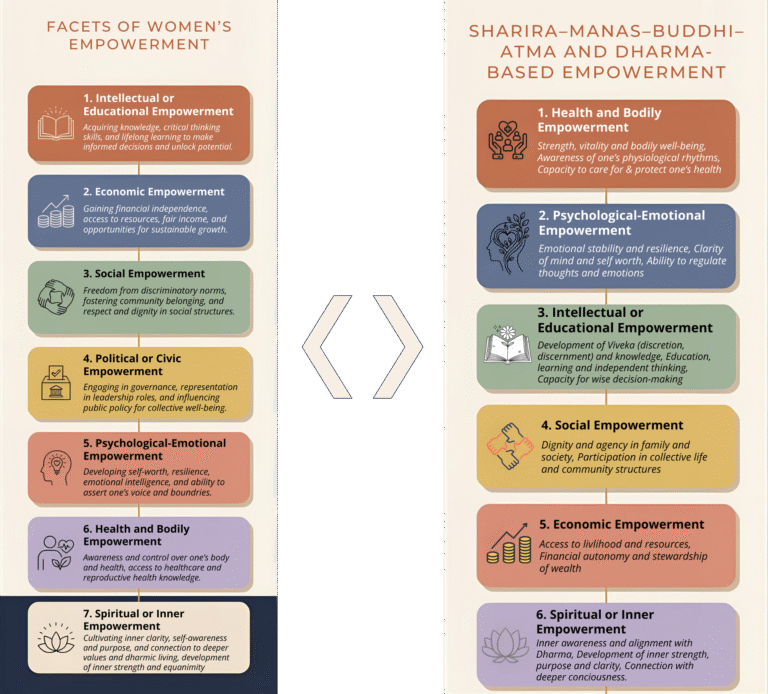
If we dissect these dimensions for better understanding, they translate into intellectual or educational empowerment, economic empowerment, social empowerment, political or civic empowerment, psychological-emotional empowerment, health and bodily empowerment, and spiritual or inner empowerment.
Lens of Bhartiya Knowledge Frameworks
If If we understand these dimensions of empowerment through the lens of Bhartiya knowledge frameworks, the perspective becomes more integrated.
Here, the development of the body, mind, intellect, society, and inner consciousness is viewed as an integrated and interconnected process, rather
than as separate domains of empowerment. In that sense, these dimensions may be articulated as Sharirika (Physical-Biological Empowerment), Manasika (Emotional-Psychological Empowerment), Bauddhika (Intellectual Empowerment), Samajika (Social Empowerment), Arthika (Economic Empowerment), and Adhyatmika (Spiritual Empowerment) Yogyata or Shakti.
The Bhartiya sciences and darshanas would also sequence these dimensions differently. The ordering usually moves from the most subtle and foundational dimensions of the human being to the more external expressions of life. It is the inner orientation that governs outer conduct. Thus, the order often proceeds from Adhyatma → Buddhi → Manas → Sharira → social and material domains.
Woman is already empowered
Beginning with Adhyatma, a woman stands as the focal anchor of the family or the family system. As far as Buddhi is concerned, Sri Krishna himself describes the intellect in women as his own manifestation. In the Bhagavad Gita, while explaining his presence throughout the world and within creation, he declares that among women he is intellect:
कीर्तिः श्रीर्वाक्च नारीणां स्मृतिर्मेधा धृतिः क्षमा।। (Vibhooti Yoga, 10.34)
Of women I am prosperity (Sri); I am fame (Kirti); I am speech (Vak); I am memory (Smrti); I am intelligence (Medha); I am endurance (Dhrti); and I am forgiveness (Ksama).
Manas and Sharira, which follow intellect in this sequence, are the forte of Ayurveda. Within Manas- the emotional and psychological realm- and Sharira -the biological and physical realm- lies the key to a woman’s holistic health.
Ayurveda provides the means to achieve or manifest the empowerment of both mind and body. Health and bodily empowerment, in this context, does not merely mean freedom from bodily exploitation or violence, nor does it limit itself to autonomy over one’s body or sexual choices. It goes deeper and speaks of true awareness of, and alignment with, one’s own body and health. The key to a woman’s holistic health lies in a well-regulated reproductive system. In Ayurveda, this regulation is supported through the practice of रजस्वला परिचर्या, the Ayurveda-prescribed menstruation routine or regimen.
Ayurveda’s Tool of Empowerment
It does not ask or expect women to withdraw; it equips them to remain prepared and empowered. It is not instant gratification that is temporary and short-lived. It is not a quick glow-up or a fleeting fix. It is transformation. It is like permanent love as against a one-night stand; it is a committed relationship as against a situationship.
There exists a complete Shastra, a full body of knowledge, dedicated to women’s life and health. That is the seriousness with which Ayurveda regards the health of a woman.
Moving from “I like myself in the mirror today” to a deeper commitment—to like yourself, to care for yourself, and to remain healthy throughout life. Explore रजस्वला परिचर्या and make an informed decision to choose to adopt it, not as a trend but as a concious step towards lifelong health and empowerment.
Learn how to adopt Rajaswala Paricharya in current times here: Rajaswala Paricharya on Brahm Varchas